Key takeaways
- The RCES exam is a 3-hour, 170-question computer-based test (150 scored plus 20 unscored pretest items) covering the EP study, mapping, catheter ablation, device therapy, and arrhythmia management.
- The exam costs $365 (including a $100 non-refundable application fee) and requires a scaled passing score of 650 on a 0–900 scale.
- CCI's published 2025 RCES pass rate is 73% for first-time test takers — roughly seven in ten.
- Candidates qualify through one of four CCI pathways: RCES1 (two years of clinical EP experience), RCES235 (health-science degree plus one year of EP experience), RCES4 (accredited EP program), or RCES5 (non-accredited program plus specialty training).
- The content blueprint is weighted toward intra-procedural activities (36%), diagnostic procedures (26%), and therapeutic procedures (21%) — over four-fifths of the exam.
- Working EP lab staff typically need 8–12 weeks of structured study; the Cardiac Codex app supporting that prep includes 179 lessons and 2,198 practice questions with explanations.
Start here: the RCES questions people actually ask
This page is the full guide. If you arrived with one specific question, these go deeper than the summary below can:
| Your question | The short answer | Full page |
|---|---|---|
| What is RCES certification? | CCI's registry credential for the EP lab | RCES certification explained |
| Am I eligible to sit? | One of four CCI pathways | RCES eligibility requirements |
| What score do I need? | 650 scaled, on a 0–900 scale | How scoring works |
| What is the pass rate? | 73% of first-time test takers (CCI, 2025) | RCES exam pass rate |
| What should I study? | Weight your time to the blueprint | RCES study guide The 8-Week RCES Study Plan |
| What should I study from? | Depends how you learn — honest comparison | Best RCES exam prep 2026 |
| What will I earn? | No credential-specific figure exists, and here is why | RCES salary |
| RCES or RCIS? | Depends which lab you work in | RCIS vs RCES |
What is the RCES credential?
The Registered Cardiac Electrophysiology Specialist (RCES) is the credential for cardiac electrophysiology (EP) lab professionals, administered by Cardiovascular Credentialing International (CCI). Earning it means passing a 3-hour, 170-question computer-based exam covering the EP study, mapping, catheter ablation, cardiac device therapy, and arrhythmia management. It is the standard registry credential employers look for in EP lab technologists and nurses.
Whether you are a cardiovascular technologist, an RT crossing over, or an RN who wants formal recognition of EP lab expertise, the RCES is the same exam for everyone — only the eligibility pathway differs. For a fuller account of what the credential is, who CCI is, and how renewal works, see RCES certification explained. If your work is in the cath lab rather than the EP lab, the companion credential is the RCIS — see our RCIS exam guide, or RCIS vs RCES if you are choosing between them.
Cardiac Codex is an independent study tool and is not affiliated with or endorsed by CCI. We can explain the published rules; only CCI can rule on your eligibility, confirm current fees, or answer anything about your application.
RCES exam quick facts
| Item | Detail |
|---|---|
| Questions | 170 total — 150 scored + 20 unscored pretest items |
| Item formats | Multiple-choice, multiple-response, hot-spot, and drag-and-place |
| Time | 3 hours, computer-based (about 2 hours 50 minutes for questions plus a short tutorial and survey) |
| Fee | $365 USD (includes a $100 non-refundable application fee) |
| Passing score | 650 scaled, on a 0–900 scale |
| Where | Pearson Professional Centers, year-round scheduling based on availability at the test centers |
| Administered by | Cardiovascular Credentialing International (CCI) |
| Renewal | 36 CEUs every 3 years (30 must be cardiovascular-related) |
Fees, policies, and blueprints change. Verify current details on CCI's official RCES page before you apply.
Who is eligible? The four pathways
You qualify for the RCES exam through one of four CCI pathways: two years of clinical EP experience (RCES1), a health-science degree plus one year of EP experience (RCES235), graduation from an accredited electrophysiology program (RCES4), or graduation from a non-accredited EP program plus documented specialty training (RCES5). All pathways also require a high-school diploma or GED.
| Pathway | Requirements | Typical candidate |
|---|---|---|
| RCES1 | 2 years of full-time work experience in diagnostic and therapeutic cardiac electrophysiology | Experienced EP tech or nurse without a qualifying degree pathway |
| RCES235 | Graduate of a health-science program (nursing, RT, paramedic, etc.) + 1 year full-time electrophysiology experience | EP lab RN or crossover RT already working in the lab |
| RCES4 | Graduate of a programmatically accredited electrophysiology program | New EP program graduate |
| RCES5 | Graduate of a non-accredited EP program with ≥1 year specialty training including ≥800 clinical hours | Graduate of a hospital-based or non-CAAHEP program |
Working out which pathway is yours takes about two minutes, and getting it wrong costs weeks — the $100 application-processing component of the fee is non-refundable. Our RCES eligibility requirements walkthrough runs the decision in order, covers what actually counts as electrophysiology experience, and lists the documentation mistakes that delay people. If you are interested in EP but not working in it yet, start instead with taking the RCES with no EP experience.
What's on the exam? The 2026 content blueprint
The RCES exam is dominated by what happens during the case: intra-procedural activities are 36% of the exam, diagnostic procedures are 26%, and therapeutic procedures are 21% — together more than four-fifths of your score. The rest covers pre-procedural activities (9%) and post-procedural activities (8%).
| Domain | Weight | What it covers |
|---|---|---|
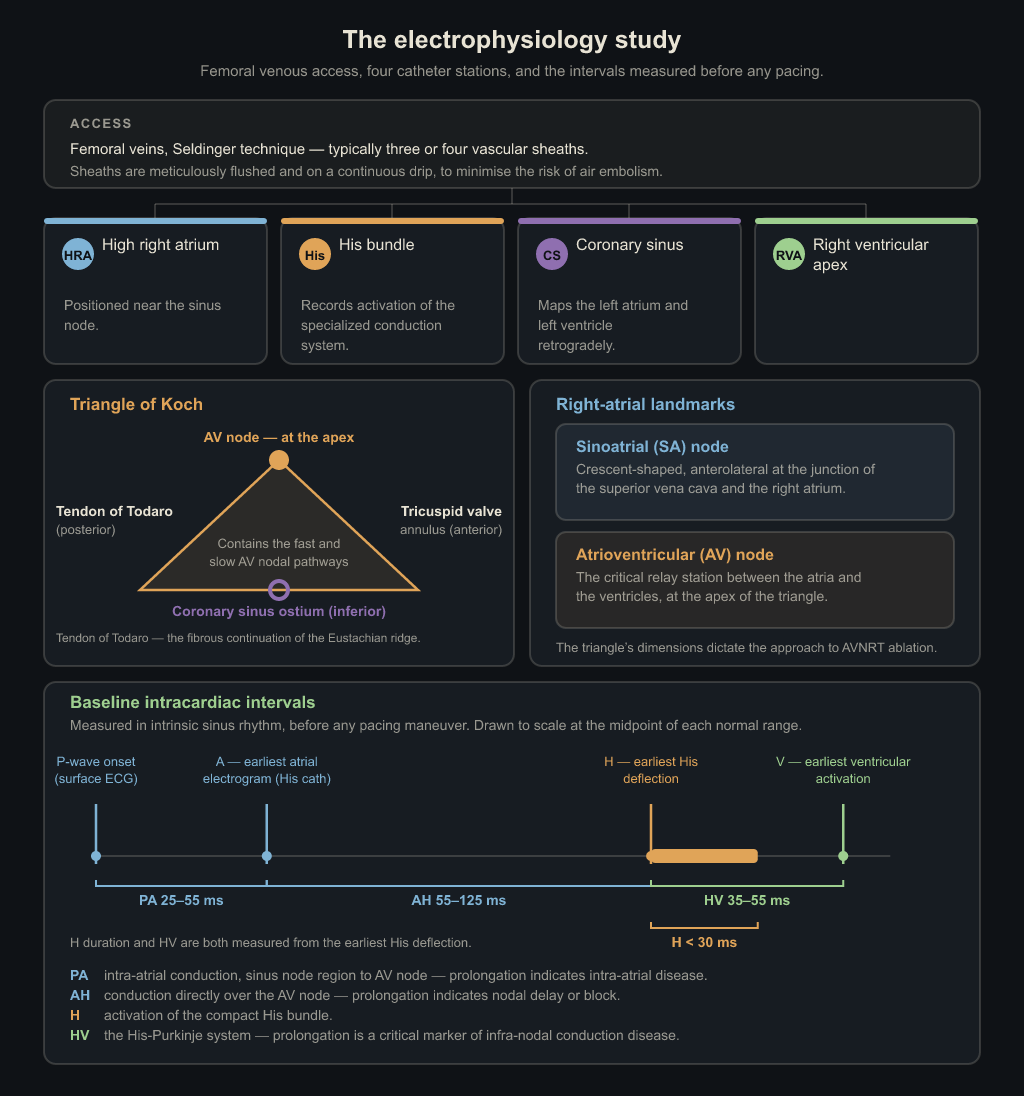
| Intra-Procedural Activities | 36% | Venous access and catheter positioning (HRA, His-bundle, coronary sinus, RV apex), the EP recording and stimulation system, signal acquisition/filtering and interval measurement, 3D electroanatomic mapping, intracardiac echo and fluoroscopy, sterile technique, rhythm and hemodynamic monitoring, radiation safety, and equipment troubleshooting during the case |
| Diagnostic Procedures | 26% | The EP study itself: baseline conduction intervals (AH, HV), programmed electrical stimulation, arrhythmia induction and mechanism (AVNRT vs. AVRT vs. atrial tachycardia, VT), accessory-pathway localization, sinus- and AV-node function, and entrainment |
| Therapeutic Procedures | 21% | Catheter ablation (radiofrequency, cryoablation, pulsed-field) and targets by arrhythmia (AVNRT slow pathway, accessory pathways, cavotricuspid-isthmus flutter, pulmonary-vein isolation for AF, VT), plus support of cardiac device implantation (pacemaker, ICD, CRT) with lead placement and device testing |
| Pre-Procedural Activities | 9% | Patient assessment, medication management (antiarrhythmic washout, anticoagulation strategy), labs and NPO status, consent, sedation planning, and baseline ECG review |
| Post-Procedural Activities | 8% | Access-site hemostasis and management, complication surveillance (tamponade, pneumothorax, vascular and phrenic-nerve injury), device interrogation and programming, patient education, and documentation |
Build your study plan around these weights. The single biggest bucket is intra-procedural — the catheters, the recording system, and the mapping technology you touch on every case — so mastery of the EP lab's tools pays back more points than any other area.
How scoring works
Your result is a scaled score from 0 to 900, with 650 required to pass. Because 20 of the 170 questions are unscored pretest items (you won't know which), answer everything with equal effort. Scaled scoring means the passing bar is calibrated to form difficulty — there is no fixed "percent correct" that guarantees a pass, which is why blueprint-matched practice exams are a better readiness signal than raw percentages on random question sets.
The pass rate
CCI's published 2025 pass rate for the RCES is 73% for first-time test takers — roughly seven in ten. That places RCES in the upper third of CCI's published range, two points below the RCIS at 75%, against a range that bottoms out at 56%.
Source: CCI student community resources, 2025 pass rates, first-time test takers. Retrieved and verified 2026-07-25. CCI updates these annually.
Two cautions on that number. First, it is unrelated to the 650 passing standard — a pass rate and a scaled score are different things that happen to look like percentages. Second, CCI publishes first-time rates only, so any retake or second-attempt figure you see quoted anywhere is unsourced. The full pass-rate page has CCI's complete table and an honest account of what the number does and does not tell you about your own odds.
The useful reading is calibration: 73% says this is a real exam that a prepared professional passes. It is not a rubber stamp, and it is not a gauntlet.
An 8–12 week study plan that matches the blueprint
Working EP lab staff typically need 8–12 weeks of structured prep: build the conduction-system foundations first, then spend most of your time on intra-procedural technique, the EP study, and ablation, and finish with full-length timed mock exams in the final two weeks.
Weeks 1–2 — Foundations
- Cardiac conduction system, action potentials, and the mechanisms of arrhythmia (reentry, automaticity, triggered activity)
- Surface ECG and intracardiac electrogram basics; normal intervals and their measurement
- Baseline self-assessment: take a diagnostic quiz and identify weak domains
Weeks 3–6 — The 83%: intra-procedural, diagnostic, and therapeutic
- Catheter placement and the standard recording sites (HRA, His, CS, RV apex) until the anatomy is automatic
- The EP recording/stimulation system and 3D mapping: signal filtering, interval measurement, activation and voltage maps
- The EP study: programmed stimulation protocols, arrhythmia induction, and distinguishing AVNRT, AVRT, and atrial tachycardia
- Ablation energy sources and targets by arrhythmia; device implant support and testing (pacemaker, ICD, CRT)
Weeks 7–8 — Pharmacology, safety, and the bookends
- Antiarrhythmic and anticoagulation management around the case; sedation
- Radiation safety, sterile technique, and intra-procedural monitoring
- Complication recognition (tamponade, pneumothorax, phrenic-nerve and vascular injury) and post-procedural care
Weeks 9–12 — Mock exams and gap-closing
- Take full-length, timed, blueprint-matched mock exams under test conditions
- Review every missed question until you can explain why the right answer is right
- Re-drill your two weakest domains in the final week
That is the outline. The full RCES study guide expands it into a domain-by-domain topic list — what to know cold in each of the five blueprint areas, where candidates reliably lose points, and the study habits that separate a comfortable pass from a retake. If you are still deciding what to study from, we compared the options, our own product included, in best RCES exam prep 2026.
Do not build the schedule before you know your baseline
The single most common wasted month in RCES prep is someone spending weeks re-drilling the domain they were already strongest in, because it felt productive. Take a scored diagnostic in week zero, get the topic breakdown, and let it decide where the eight to twelve weeks actually go.
Find your weak domain in 25 questions
A free RCES diagnostic matched to the CCI blueprint, with a topic-level breakdown of where you actually stand and a worked explanation for every answer. Pick your exam and the first question loads immediately — the questions start right away, and no email is required.
Start the free diagnosticPrefer to browse first? Try 25 free RCES practice questions with worked explanations, or read the RCIS & RCES glossary for the EP terms this exam assumes you know. The full Cardiac Codex app carries 179 lessons, 2,198 practice questions with explanations, four full-length blueprint-matched mock exam forms (two RCES and two RCIS), flashcards, mastery tracking, and Cardiac Coach, an AI tutor grounded in the curriculum that you can ask from any lesson or missed question.
RCES exam FAQ
How many questions are on the RCES exam?
170 questions — 150 scored and 20 unscored pretest items — over 3 hours on a computer at a Pearson Professional Center. Item formats include multiple-choice, multiple-response, hot-spot, and drag-and-place.
How much does the RCES exam cost?
$365 USD, which includes a $100 non-refundable application-processing fee. Confirm the current fee on CCI's site before applying.
What score do you need to pass?
A scaled score of 650 on a 0–900 scale. It is a scaled score, not a percentage.
What is the RCES exam pass rate?
73% for first-time test takers, per CCI's published 2025 figures — two points below the RCIS at 75%. CCI publishes first-time rates only, so any retake figure you see quoted is unsourced. Full table and context.
What are the RCES eligibility requirements?
A high-school diploma or GED plus one of four CCI pathways — RCES1, RCES235, RCES4, or RCES5. Work out which one is yours.
What is the RCES salary?
There is no reliable credential-specific figure, because federal wage data is not broken out by credential. We explain what the closest verified number is, and why we decline to publish an RCES-specific one, on the RCES salary page.
Can nurses take the RCES exam?
Yes — RNs commonly qualify under the RCES235 pathway: health-science graduate + one year of full-time cardiac electrophysiology experience.
How long should I study?
Plan 8–12 weeks of structured study while working, weighted toward intra-procedural (36%), diagnostic (26%), and therapeutic (21%) domains.
What's the difference between RCES and RCIS?
RCES is the EP lab credential (EP studies, mapping, ablation, devices). RCIS is the cath lab credential (hemodynamics, angiography, PCI). Cardiac Codex covers both blueprints.
How do I keep the credential after passing?
CCI registry credentials renew every 3 years with 36 CEUs, 30 of which must be cardiovascular-related.